
About this free template pack
This free business plan template pack gives you the two documents every plan is built on: the numbers and the narrative. Download the 3-year financial projections Excel model (working formulas — just add your numbers) and use the printable one-page template to get the story straight.
No email required. No trial. Free, from a CPA who writes plans for a living.
These tools are for founders, owners, students, advisers, and teams testing a new venture or organizing an existing one. They make internal planning clearer. If the finished plan will support a bank loan, investor round, or acquisition, use the templates to prepare and then ask a CPA to review the assumptions and projections.
Want the full narrative drafted too? Our free AI business plan generator builds the complete document around your numbers.
Template 1: the numbers
The 3-year financial projections Excel model
This business plan template Excel workbook connects a central assumptions sheet to a monthly first-year profit and loss statement, three-year annual summary, and simplified cash-flow view. It gives you a transparent starting point instead of a black-box result.
Free financial projections template
Open the workbook in any compatible spreadsheet app, edit the yellow assumptions, and review the formula-driven results.
Download the free Excel template.xlsx file · no email required
What's inside:
- Assumptions sheet — every input in one place: revenue, growth rates, margins, expenses, startup costs. Yellow cells are yours to edit.
- Year-1 monthly P&L — month-by-month profit and loss, formula-driven from your assumptions.
- Years 1–3 annual summary — the three-year view lenders ask for.
- Annual cash flow — simplified: opening balance, net profit, closing balance. A negative closing balance means you need more capital — fix it before a lender sees it.
How to use it: replace every yellow cell with your real numbers — quotes, wage rates, rent, pipeline. The formulas do the rest. Then sanity-check the output: does Year 1 look like a business you've actually seen?
Begin with evidence rather than a desired profit. Enter achievable monthly sales, the direct cost required to deliver them, and the operating costs that continue even in a slow month. Keep notes outside the workbook for the source and date of each important figure. Supplier quotes, lease terms, wage rates, sales-capacity calculations, and customer pipeline data make assumptions easier to explain and update.
Read the results in sequence. First, check gross margin: is it consistent with the way the business prices and delivers its offer? Next, check operating profit and whether staffing, marketing, occupancy, and professional costs appear in the right periods. Finally, read cash flow. A profitable year can still contain a cash shortfall if startup purchases and operating payments happen before customers pay.
Disclaimer: this is a planning template, not financial advice. Figures are illustrative until you replace them with your own. Before borrowing or investing, have a CPA review your projections.
Why this matters: lenders don't fund templates — they fund arithmetic they can audit. A model whose assumptions you can defend beats a prettier one you can't explain.
Template 2: the narrative
The one-page business plan template
Work through each box below in order. One page forces the discipline a 40-page plan often hides: if you can't say it here, you don't understand it yet.
The aim is not to squeeze every fact into nine boxes. It is to name the decisions that matter and expose where evidence is missing. Write plainly, use numbers when they clarify the point, and distinguish facts from assumptions. You can print a blank copy, write by hand, or use each prompt as a heading in your own editable document.
1. Business name & tagline.
What do you sell, in one line a stranger understands?
2. The problem.
Whose painful, expensive problem are you solving? Be specific — "small businesses struggle" is not a problem.
3. Your solution.
What you sell, and why it's better than what they do today (not better than competitors — better than doing nothing).
4. Target customers.
Who buys first? Name them narrowly: industry, size, location, situation.
5. How you make money.
Revenue model in one paragraph: what you charge, how often, and your average sale.
6. Startup costs.
Total cash needed to open the doors — from real quotes, not guesses.
7. Funding needed.
How much you're raising or borrowing, what type (loan, line, investment), and what it buys.
8. Three-year goals.
Revenue, customers, and team at the end of years one, two, and three. Conservative beats impressive.
9. Why you'll win.
Your unfair advantage: experience, relationships, location, costs, or focus. One paragraph, no adjectives you can't prove.
Learn the thinking behind every box
Business Plan Essentials shows how the sections connect, with examples that help you move from a one-page outline to a lender-ready plan.
Finished? Paste your answers into the free AI business plan generator and it will expand them into a full structured draft.
When a template isn't enough
Honest guidance: templates are for thinking and internal planning. They are not, by themselves, a bank submission. When money is on the line — a term loan, a CSBFP application, an investor round, an acquisition — lenders expect CPA-grade projections with documented assumptions and a funding request structured the way underwriters read.
That's what our business plan writing services deliver: your numbers, modeled and reviewed by a CPA, in a plan built to survive a credit committee.
A consequential plan also needs consistency between documents. The sales forecast must match the customer-acquisition activities in the narrative. Hiring dates must match payroll. Equipment purchases and opening inventory must appear in the use of funds and cash flow. Loan payments need to reflect the proposed amount, rate, and term. A reviewer will notice when those pieces tell different stories.
Bank requirements vary by institution and transaction, while investors evaluate opportunities against their own mandate. Confirm the recipient's current checklist before submission. A professional review cannot promise approval, but it can identify unsupported claims, formula errors, missing costs, and funding gaps while there is still time to correct them.

Go deeper: the book behind the templates
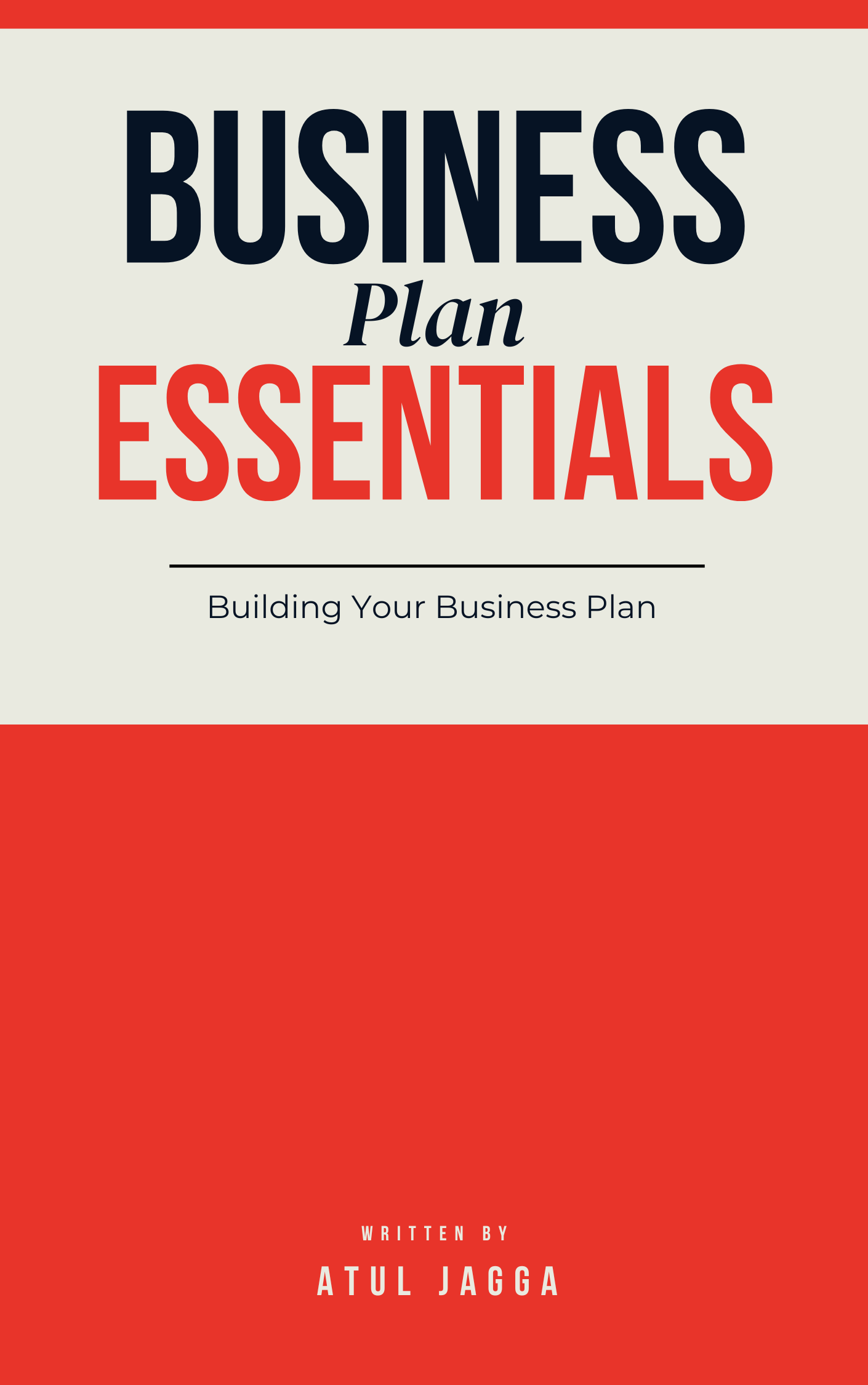
The thinking in these templates comes from Business Plan Essentials: Building Your Business Plan — the 196-page guide by Atul Jagga that walks through every section of a lender-ready plan, with examples. Get it on Amazon.
The book is useful when a one-page answer reveals a question you cannot yet resolve. It explains how to research the market, translate strategy into operations, develop financial assumptions, and present the result for a specific audience. The template provides the frame; the guide teaches the reasoning that makes each answer credible.
If you want a quicker first draft, the free business plan generator can organize your inputs into a fuller structure. Treat that draft as the beginning of review, not the end: verify every factual statement, reconcile it to the model, and replace generic claims with evidence from your market.
Frequently asked questions
Is a free business plan template enough for a bank loan?
For organizing your thinking, yes. As a loan submission, no — banks expect complete financial projections with documented assumptions, which a static template can't generate for you. Use the Excel model above for the numbers, then either expand it yourself or have it professionally reviewed before submitting. Our writing services exist for exactly that step.
What's the difference between the Excel model and the one-page template?
The Excel model is the numbers: revenue, costs, profit, and cash flow over three years, formula-driven. The one-page template is the narrative: problem, solution, customers, and strategy on a single page. A complete plan needs both — which is why they're bundled here.
Do I need Excel to use the financial model?
You need a spreadsheet app that reads .xlsx files — Microsoft Excel, Google Sheets (File → Import), LibreOffice, or Apple Numbers all work. Formulas are standard and carry over.
Can I use these templates for an investor pitch?
As a starting point, yes — investors will expect the same fundamentals. But investor plans need additional sections (use of funds, return logic, exit framing) that a template doesn't write for you. The AI generator covers more of that structure, and our writing services build investor-grade plans.
Are these templates really free? What's the catch?
They're free, no email required, no catch. We make money writing professional plans — the templates are how founders find us when the stakes get serious. If a template site asks for your email before downloading, that's their business model, not ours.
About the author

Written by Atul Jagga, CPA Ontario — Founder of The Biz Plans, Toronto. MBA Finance & Strategy (UBC); 20+ years in corporate finance and consulting involving RBC, BMO, and CIBC; author of Business Plan Essentials: Building Your Business Plan (2025). Get the book · Professional plan writing services
Related: Free AI Business Plan Generator · Business Plan Writing Services · Canadian Business Plan Benchmarks 2026
Need a plan reviewed for a real funding decision?
Discuss the audience, financing request, evidence, and financial model with our business planning team.